
How to Prepare for an Interview in 7 Days: A Day-by-Day Plan
 Ezlun Team9 min read

How to prepare for an interview in a week: split the work by day. Spend days 1-2 on your CV and the job description, days 3-5 practicing questions by type, day 6 on your self-introduction and questions for the employer, and day 7 on light review, logistics and rest.
This guide gives a concrete schedule for each day, what to produce by the end of it, and which Ezlun tool helps at each step. If you only have two days, there is a short version near the end.
Where should interview prep start?
Start with the application you actually sent and the job description (JD), not with a generic list of questions online. Interviewers mostly ask about two things: the experience on your CV and the requirements in the JD.
Before day 1, have these ready:
The exact CV you sent to this company.
The JD for the role (save a copy, since job ads get taken down).
Basic company research: products, customers, recent news.
Interview details: time, format (in person or online), interviewer names if you have them.
Here is the full seven-day plan. One to two hours a day is enough if you are working.
Day | Main task | What you should have by the end | Suggested tool |
|---|---|---|---|
1 | Reread your CV and mark what could be asked | 5-7 key experiences, each with numbers | CV Checker |
2 | Match your CV to the JD and find the gaps | Your 3 strongest JD requirements and 2 weaker ones | CV Checker (with the JD) |
3 | Practice general questions (introduction, strengths, why you are leaving) | Outlines for 5-6 general questions | Interview Questions |
4 | Practice role-specific questions | Outlines for the common questions of your role | Interview Questions |
5 | Practice behavioral questions out loud, timed | 3-4 stories in STAR format | Interview Questions |
6 | Prepare your introduction and questions for the employer | A 1-2 minute introduction and 3 questions to ask | - |
7 | Light review, logistics, rest | Outfit, route or devices ready | - |
Days 1-2: review your CV and the job description
The goal of the first two days is to know exactly what you will be asked about yourself. Every line on your CV can become "Can you tell me more about that?"
Day 1: reread your CV.
Print or open the CV and highlight every number and result.
For each main experience, write down the context, what you did, the result and what you learned.
Mark the spots that may draw hard questions: gaps in dates, short stints, skills listed but rarely used.
Day 2: compare it with the JD.
Underline the requirements the JD repeats.
Pair each requirement with one experience on your CV as evidence.
For requirements with no evidence yet, prepare an honest answer: how far you have gone with it and how you plan to learn.
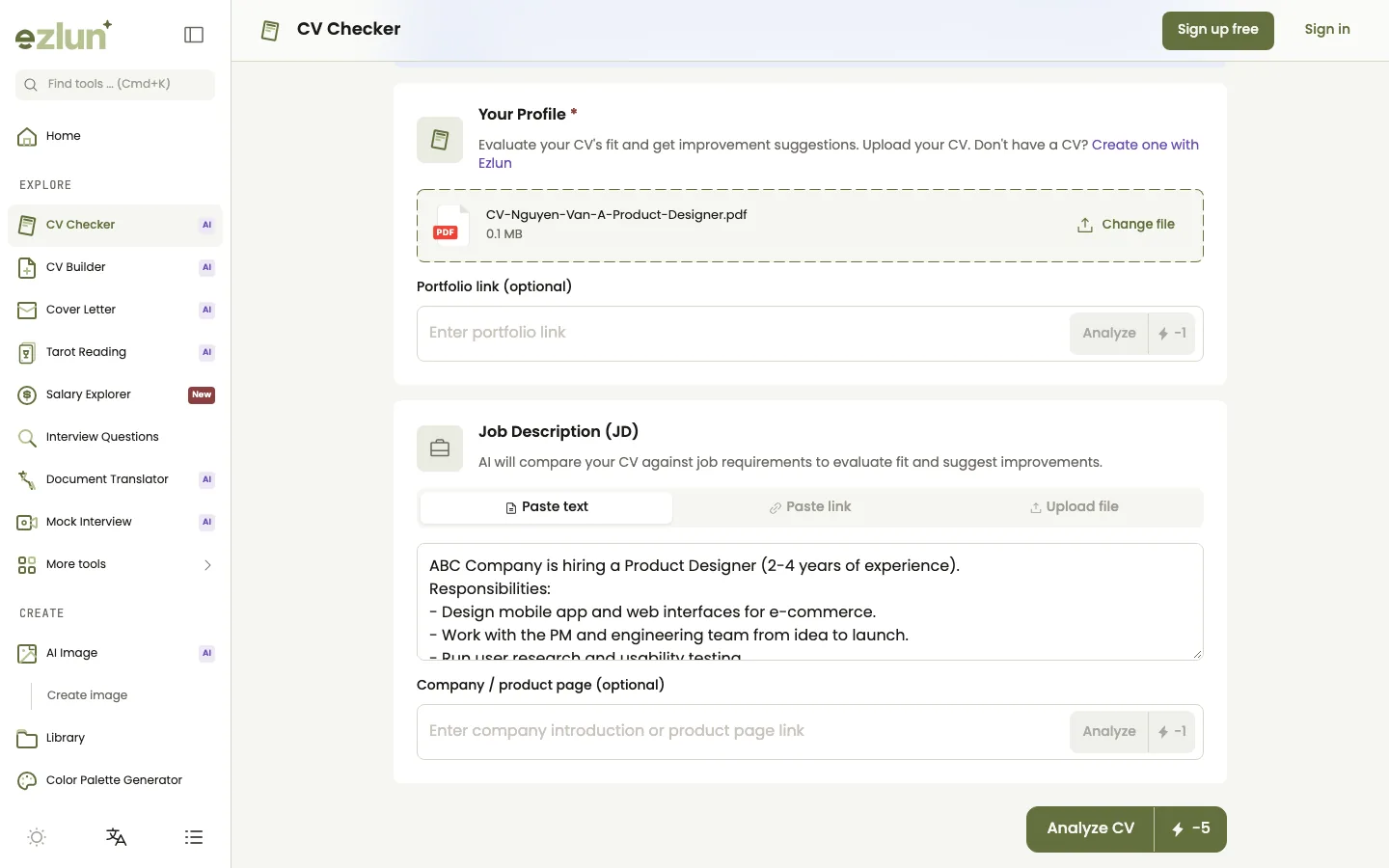
Upload the CV and paste the JD to see which requirements you can back up and which ones are thin.
For a second opinion, Ezlun's CV Checker scores your CV on criteria for your field and compares it with the JD you paste in (5 credits per report). Its "Interview Questions" tab suggests questions an employer may ask based on your CV, which is exactly what you need on day 2. The guide on how to check your resume before applying explains how to read the report.
Days 3-5: practice interview questions for your role
The middle three days are the core of the plan. Split by question type so it stays manageable: general questions on day 3, role-specific on day 4, behavioral on day 5.
How to practice each question:
Read the question, think of your answer first and write a 3-4 point outline.
Compare it with the answer framework and hints.
Say the answer out loud and time it. Most answers should take 1-2 minutes.
Note where you stumbled so you can try again the next day.
Do not memorize answers word for word. Interviewers spot recited answers quickly, and you are more likely to freeze when a question is phrased differently. Remember the outline and the example, and let the wording come naturally.
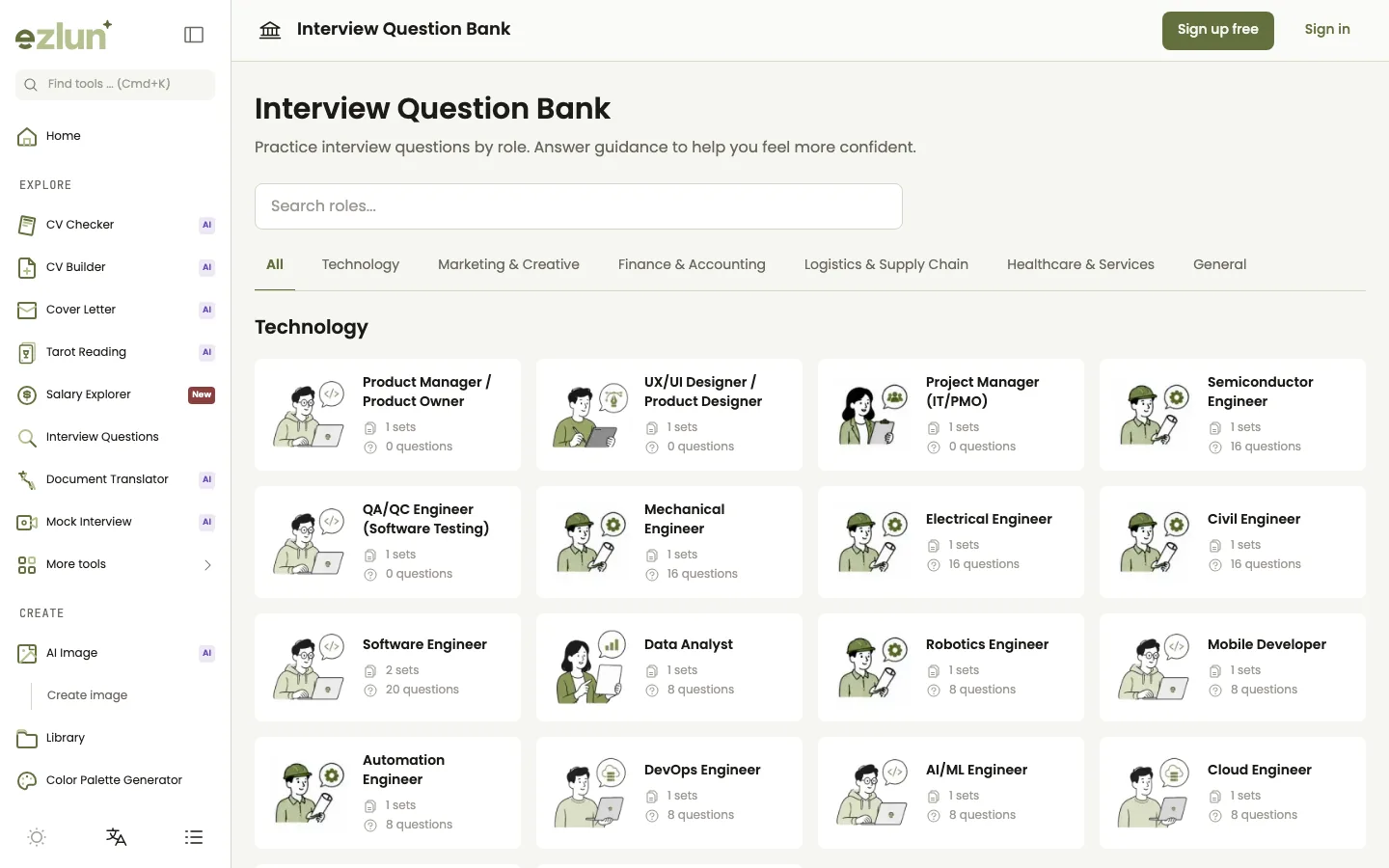
Pick the role you applied for so the question set matches the job.
Ezlun's Interview Questions groups questions by role and question set. Each question shows how often it comes up and roughly how long an answer should take. When you press "View answer hint", you see an answer framework, what recruiters want to hear, and common mistakes. The tool prompts you to think about your answer before viewing the hint, which is the same method described above. The question bank does not use credits; viewing hints requires a free account.
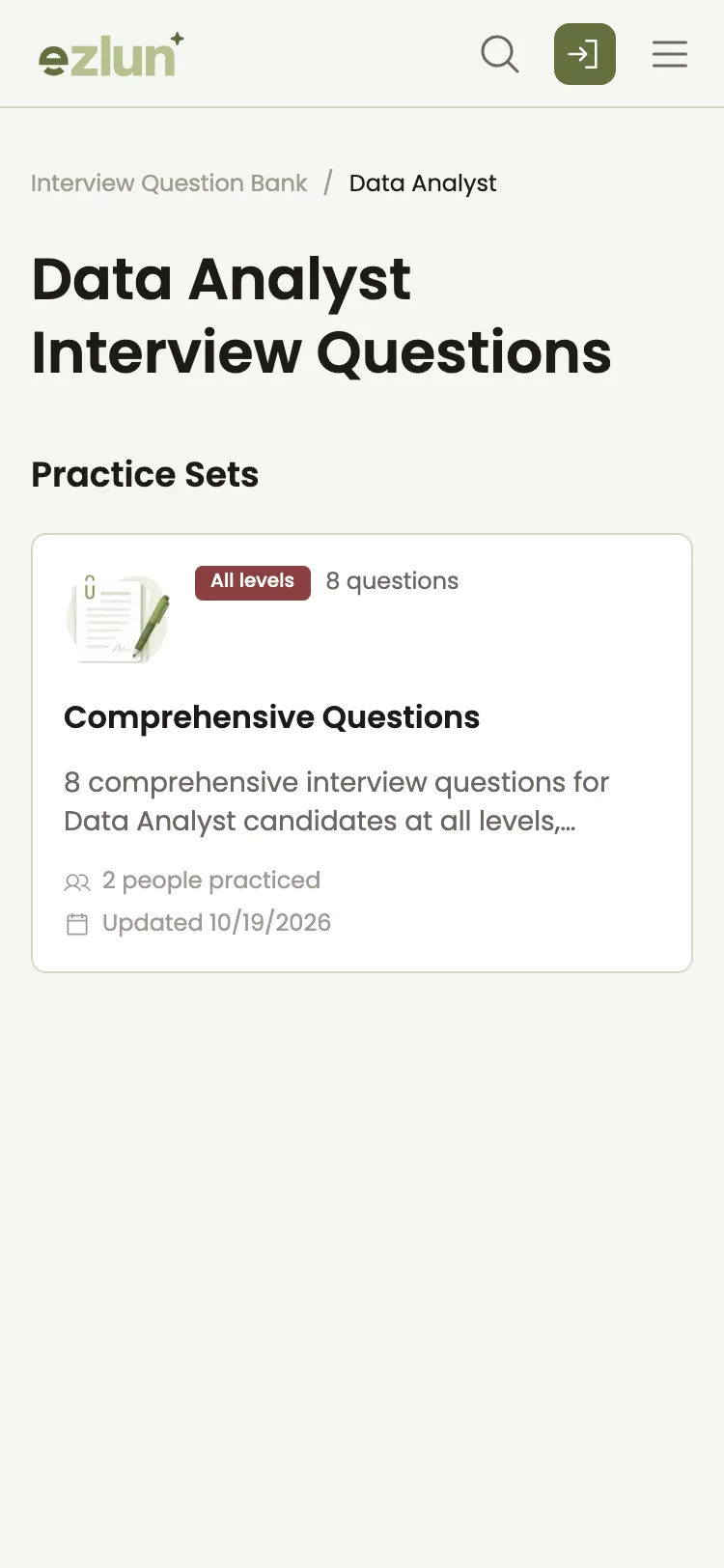
Practice on your phone when you have 15-20 spare minutes in the day.
For a full walkthrough of the question sets, see how to practice interview questions by job role. For general questions, common interview questions and how to answer them persuasively is a good companion.
The STAR format for behavioral questions (day 5):
Part | What to say | Suggested length |
|---|---|---|
Situation | The context: when and where | 1-2 sentences |
Task | What you were responsible for | 1 sentence |
Action | What you did, step by step | 3-4 sentences, the longest part |
Result | What happened, with numbers if possible, and what you learned | 1-2 sentences |
Prepare 3-4 different STAR stories: handling a conflict, a mistake you fixed, an achievement, and working under pressure. One good story can answer several questions.
Day 6: prepare your introduction and questions for the employer
"Tell me about yourself" is almost always the first question, so it deserves its own day. A 1-2 minute introduction usually follows this order: what you do now, your most relevant experience, the strength that fits this role, and why this job interests you.
How to build it:
Write it out, then cut until it takes about 1-2 minutes to say out loud.
Mention only 1-2 experiences and save the detail for later questions.
End with a line that connects to the role you are interviewing for.
How to introduce yourself in an interview has examples for different situations.
Questions for the employer. Near the end you will usually hear "Do you have any questions for us?" Have three ready, for example:
What does a typical day look like in this role?
What should the person in this role achieve in the first three months?
How does the team usually work together?
Day 7 and after the interview
Do not learn anything new on the last day. Review your outlines, say your introduction once or twice, then sort out logistics.
Day 7 checklist:
In person: outfit, route, travel time, a printed CV.
Online: test the meeting link, microphone, camera, lighting and connection. The online interview preparation checklist has the full list.
Get enough sleep. A rested evening helps more than one extra hour of review.
After the interview, send a thank-you email the same day or the next: thank them for their time, mention one point that shows you fit the role, and say you look forward to hearing back. Interview follow-up email: 5 templates has examples you can adapt. If you want a quick draft, Ezlun's Cover Letter tool writes from your CV and the JD (3 credits per letter); edit it into your own voice before sending. How to write a cover letter from a job description shows how to edit an AI draft.
Write down the questions you answered poorly right after the interview. That list is valuable for the next one. 10 common interview mistakes and how to fix them helps you review what went wrong.
What if you only have 2 days?
With little time, keep the three most important tasks and drop the rest:
Time | What to keep |
|---|---|
Day 1, morning | Reread your CV and pair 3 key JD requirements with your experience |
Day 1, evening | Practice the 5 most common questions for the role, out loud and timed |
Day 2, morning | Your introduction and 3 questions for the employer |
Day 2, evening | Logistics and rest |
Prioritize the questions marked "Very common" in the set for your role.
Limits of the plan and the tools
The 7-day plan is a framework. Put more time into your weakest area; if you interview often, you can shorten day 3.
Answer hints are frameworks, not scripts. The best answer uses your real experience.
CV Checker reports are generated by AI and can be wrong; read them with your own knowledge of the job.
Your application is the foundation of the interview. If it is not ready yet, go back to the job application documents checklist. If this is your first interview after graduating, the fresh graduate job checklist for Vietnam has more tips.
Frequently asked questions
Is one week enough to prepare for an interview?
For most roles, a week of 1-2 hours a day is enough to know your CV well, practice the common questions and prepare your introduction. Roles with in-depth technical tests may need extra time to review the subject matter.
How many interview questions should I practice each day?
Around 5-8 questions a day, practiced properly (outline, say it out loud, time it), usually helps more than skimming dozens. Come back to the ones you stumbled on the next day.
Should I bring a printed CV to the interview?
Yes, for in-person interviews. Bring one or two printed copies of the exact CV you sent, in case the interviewer does not have one or someone else joins.
When should I ask about salary?
Usually when the employer raises it, or in a later round once both sides are interested. Research the market rate first so you have a reasonable number; how to negotiate salary in an interview has suggested wording.
How do I deal with interview nerves?
Nerves are normal. Practicing out loud several times makes your answers familiar, which takes some of the pressure off. In the interview itself, it is fine to ask for a few seconds to think before answering a hard question.
Summary
A good plan for how to prepare for an interview in a week goes in this order: two days on your CV and the JD, three days practicing questions by type, one day for your introduction and questions to ask, and one day for rest and logistics. Practice out loud with a timer, and use real experience in every answer.
You can start day 3 with Ezlun's Interview Questions by picking the role you are about to interview for.


