
How to Compare Job Offers in Vietnam: Gross vs Net, Tax and Benefits
 Ezlun Team9 min read

To compare job offers in Vietnam when one is gross and one is net, convert every offer into the same measure: the money you actually receive each month after mandatory insurance and personal income tax. Only then look at the insured salary, bonuses and benefits, because the higher net figure is not always the better offer.
This guide explains how gross and net differ in Vietnam, works through three example offers under the 2026 rules, and lists what to ask beyond the salary before you accept.
What is the difference between a gross and a net offer?
Gross salary is total pay before compulsory insurance contributions and personal income tax (PIT). Net salary is what reaches your bank account after those deductions.
With a gross offer, you carry the insurance and tax: if the rules or your situation change (for example, you register a dependent), your take-home pay changes too. With a net offer, the employer commits to the take-home amount and works backwards to a gross figure to pay insurance and tax.
Gross offer | Net offer | |
|---|---|---|
The number in the offer | Before insurance and tax | After insurance and tax |
Who absorbs changes in tax or insurance | The employee | Usually the employer, depending on the contract |
Benefit from registering dependents | You get the lower tax | Depends on the agreement, ask |
Easy to compare with the market | Yes, job ads in Vietnam usually quote gross | Needs converting |
Net vs gross salary: a detailed calculation guide explains the two terms in more depth. To follow each line of the calculation, see the gross to net salary formula for Vietnam.
Convert every offer to take-home pay
There are three steps:
For a gross offer: subtract the employee's compulsory insurance (10.5% of insured salary, with a cap), subtract the family deductions to get taxable income, apply the progressive PIT rates, then take gross minus insurance minus tax.
For a net offer: that number already is your take-home pay. Convert it back to gross if you want to know what the employer is paying.
Line the numbers up under the same assumptions: same region, same number of dependents.
Here are three example offers. Assumptions: you work in Region I, have no dependents, are taxed as a resident, and insurance is paid on the full salary.
Offer A | Offer B | Offer C | |
|---|---|---|---|
Stated in the offer | 30,000,000 VND gross | 28,000,000 VND gross | 26,000,000 VND net |
Employee insurance (10.5%) | 3,150,000 VND | 2,940,000 VND | about 3,122,000 VND |
Taxable income | 11,350,000 VND | 9,560,000 VND | about 11,111,000 VND |
Personal income tax | 635,000 VND | 478,000 VND | about 611,000 VND |
Monthly take-home pay | 26,215,000 VND | 24,582,000 VND | 26,000,000 VND |
Equivalent gross | 30,000,000 VND | 28,000,000 VND | about 29,733,000 VND |
How the tax line for offer A works: taxable income = 30,000,000 - 3,150,000 - 15,500,000 (personal deduction) = 11,350,000 VND. Tax = 10,000,000 x 5% + 1,350,000 x 10% = 500,000 + 135,000 = 635,000 VND.
What the table shows: offer A (30 million gross) pays about 215,000 VND a month more than offer C (26 million net), even though the headline numbers differ by 4 million. Offer B is the lowest of the three.
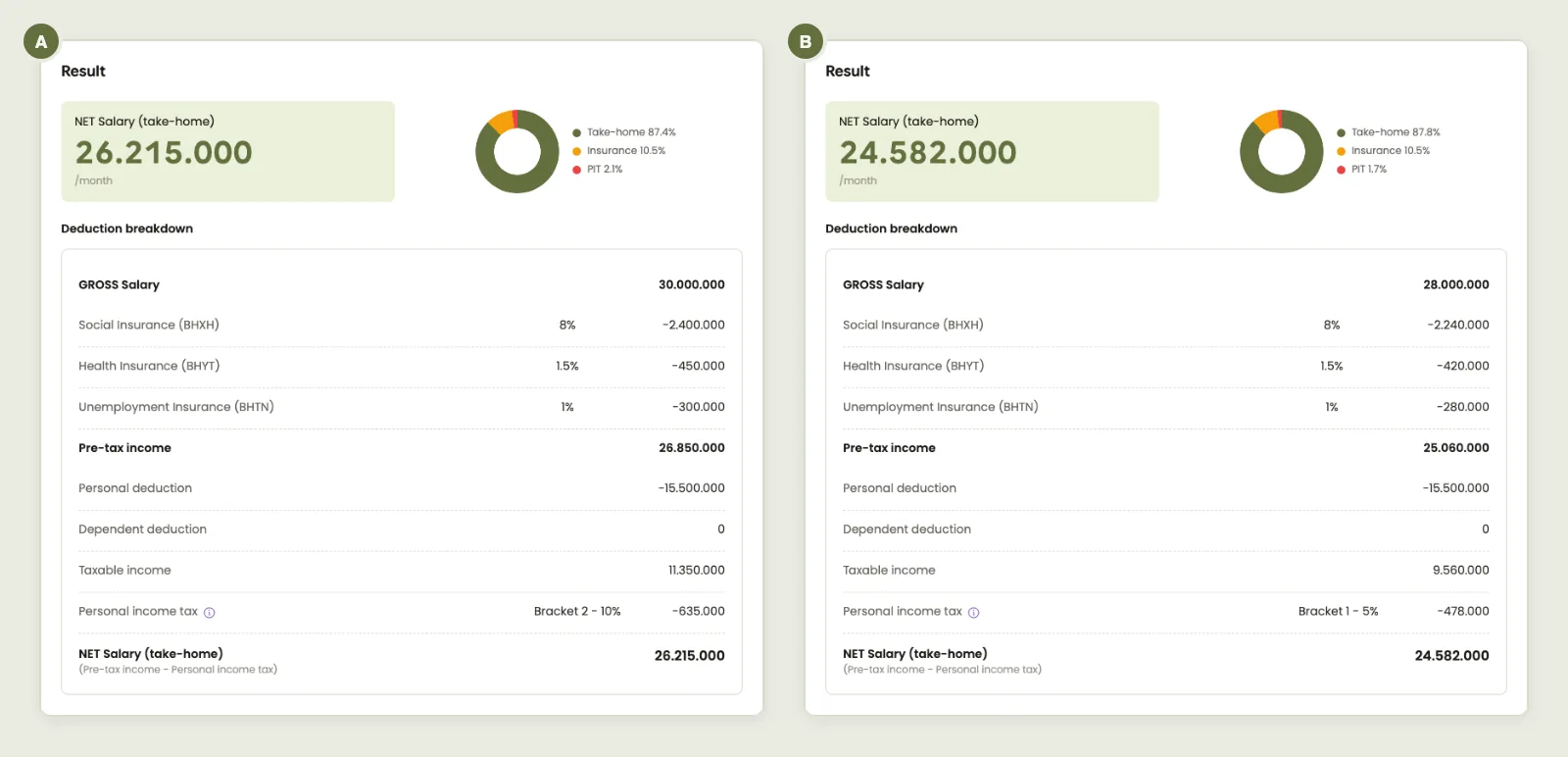
Results for offer A (30 million gross) and offer B (28 million gross) side by side.
How do personal income tax and dependents change the result?
PIT is charged on income after insurance and family deductions, using five progressive brackets from the 2026 tax period: 5% on the first 10 million VND, 10% above 10 and up to 30 million, 20% above 30 and up to 60 million, 30% above 60 and up to 100 million, and 35% above 100 million.
The family deduction is currently 15,500,000 VND a month for yourself and 6,200,000 VND a month for each registered dependent. For offer A, with one dependent:
Taxable income drops to 5,150,000 VND.
Tax drops from 635,000 VND to 257,500 VND.
Take-home pay rises to 26,592,500 VND.
With a net offer, who keeps that tax saving depends on the contract. Many employers that pay net keep your take-home amount fixed, which means the saving goes to the company. If you have dependents, ask about this before you sign. The guide to personal income tax deductions in Vietnam explains who counts as a dependent and how to register them.
If you are a foreign employee, two extra points matter. First, your tax treatment depends on whether you are a tax resident in Vietnam. Ezlun's PIT Calculator has a separate mode for non-residents, who pay a flat 20% on Vietnam-sourced employment income instead of the progressive brackets. Second, the rules on which insurance contributions apply to foreign employees can differ from those for Vietnamese staff. Confirm both points with HR before comparing offers.
Beyond salary: insured salary, bonuses and benefits
Take-home pay is only part of the picture. Two offers with the same net amount can still be quite different.
Insured salary. Some offers state a high salary but pay insurance on a lower base. Your take-home pay is higher now, but your insurance benefits later are lower. Using offer A at 30 million gross:
Insurance on 30 million | Insurance on 10 million | |
|---|---|---|
Employee insurance | 3,150,000 VND | 1,050,000 VND |
Personal income tax | 635,000 VND | 845,000 VND |
Monthly take-home pay | 26,215,000 VND | 28,105,000 VND |
Estimated monthly unemployment benefit if you lose the job (60% of insured salary) | 18,000,000 VND | 6,000,000 VND |
The lower insurance base gives you almost 1.9 million VND more each month, but the estimated unemployment benefit falls to about a third. Pension, maternity and sickness benefits are also based on what you contribute. This is why "what is the insured salary?" is worth asking for every offer.
Other things to ask:
Bonuses: written into the contract, or dependent on company results.
Private health insurance and regular health checks.
Allowances (lunch, travel, phone) and which ones count toward insured salary.
How raises work and when the first salary review happens.
Annual leave and remote work.
Negotiating the offer
Once the offers are on the same scale, you have a solid basis to negotiate. A few tips:
Use one kind of number. If you want 26 million in take-home pay, say net clearly, or convert to the gross equivalent before you propose it.
Rely on facts, not feelings: market rates for the role, your experience, other offers you hold.
Negotiate the package, not only the salary: insured salary, bonus, timing of the first review.
How to negotiate salary in an interview: 7 steps has specific wording for different situations.
Calculate each offer with Ezlun
Ezlun's Salary Calculator does the full calculation for you:
Choose the direction: GROSS → NET or NET → GROSS.
Enter the salary, or pick one of the preset amounts.
Choose whether insurance is paid on the full salary or on a different amount.
Choose your region and number of dependents.
Read the breakdown: each insurance contribution, tax per bracket, take-home pay and the employer's total cost.
It is free and does not require an account. Run it once for each offer, then copy the results into a comparison table like the one above.
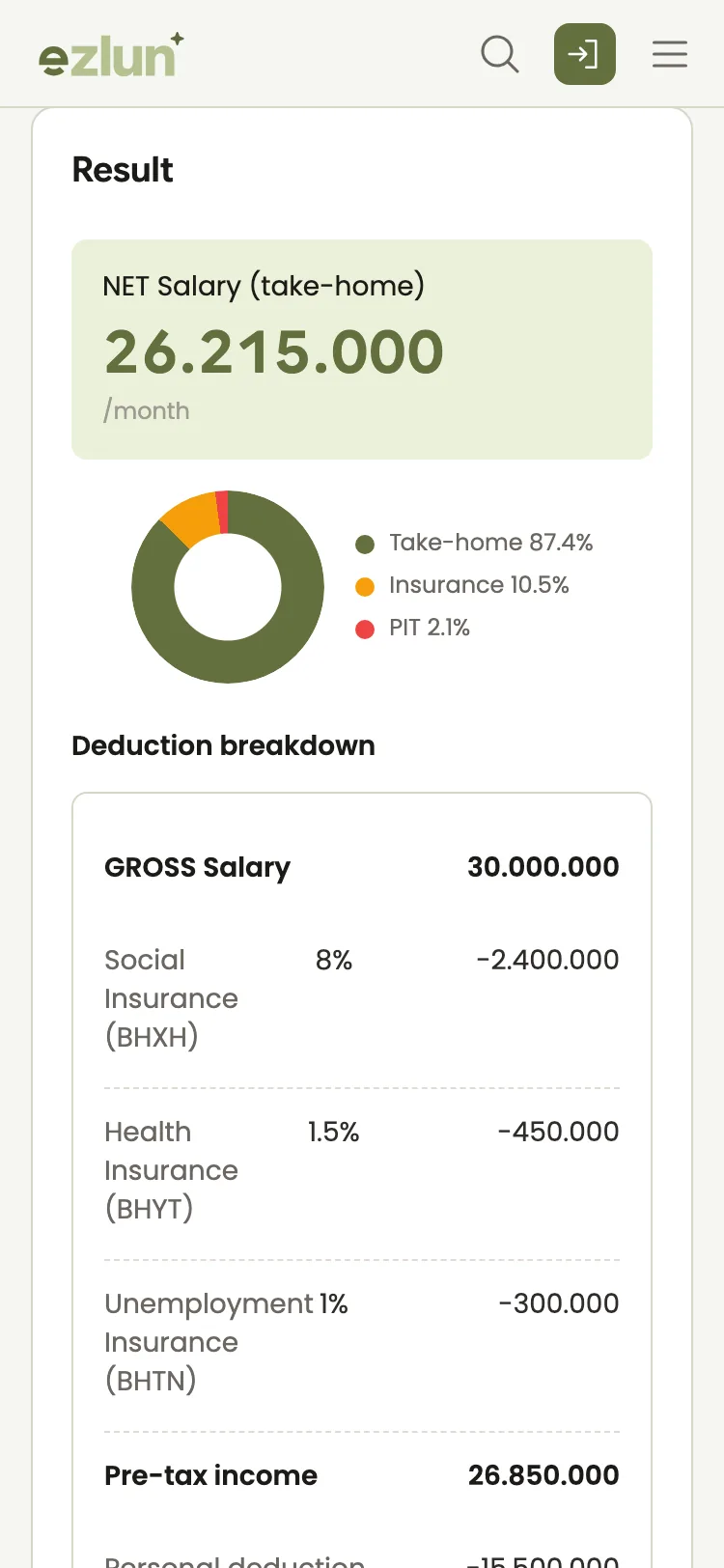
The result on a phone: take-home pay at the top, insurance and tax lines below.
If you have income on top of your salary, or you want the non-resident calculation, use Ezlun's PIT Calculator.
Legal basis and limits of the calculation
The numbers in this guide follow the rules the tools currently apply: Personal Income Tax Law No. 109/2025/QH15 (applied from the 2026 tax period) and its implementing Decree 253/2026/ND-CP, Social Insurance Law No. 41/2024/QH15, Employment Law No. 74/2025/QH15, and Decree 293/2025/ND-CP on regional minimum wages, with a reference level of 2,530,000 VND a month from 1 July 2026. Updated October 2026.
These figures are for reference only; please check them against official sources. The calculation is not tax or legal advice. Your actual result may differ if you have other income, tax-exempt allowances, or if your employer uses a method set out in your contract.
When you later think about leaving a job, the quit your job checklist for Vietnam helps you keep track of final pay and paperwork. If this is your first offer after graduating, see the fresh graduate job checklist for Vietnam.
Frequently asked questions
Should I negotiate in gross or net?
Gross is usually easier to compare with the market, because most job ads in Vietnam quote gross. Net tells you exactly what you will receive. What matters is saying clearly which one you mean and converting before you compare.
Is probation pay different from the full salary?
It can be. Under Article 26 of Vietnam's 2019 Labor Code, probation pay is agreed by both sides but must be at least 85% of the salary for the job. Ask about the probation salary, how long probation lasts and the salary afterwards.
Do allowances count toward insured salary?
It depends on the type of allowance and how the contract describes it. Some count toward insured salary and some do not. Ask HR for the specific list, because it affects both take-home pay and your insurance benefits.
How do I compare an offer paid in a foreign currency?
Convert it to VND at the exchange rate you expect to receive, then treat it like any gross or net offer. Ask which rate the employer uses and when it is applied, since exchange rate changes move your take-home pay.
Is the higher net offer always better?
No. As the example shows, a 26 million net offer can pay less than a 30 million gross offer. You also need to weigh insured salary, bonuses and benefits.
Summary
To compare job offers in Vietnam, gross vs net, convert every offer to take-home pay under the same assumptions, then weigh insured salary, dependents, bonuses and benefits. The bigger number on paper is not always the better offer.
You can run each offer through Ezlun's Salary Calculator, free and without an account.


