
Personal Income Tax Deductions in Vietnam: Personal and Dependent Allowances Explained
 Ezlun Team9 min read

Personal income tax deductions in Vietnam, called family deductions, are amounts taken off your income before personal income tax (PIT) is worked out: VND 15.5 million per month for the taxpayer and VND 6.2 million per month for each dependent. If your income after insurance is below your total deductions, you pay no tax on your salary.
This guide explains who counts as a dependent, which documents you usually need and how the deductions change the tax you pay, with a worked example.
What are family deductions in Vietnam?
They are the part of your income the state lets you keep to support yourself and your family, so it is not taxed. There are two kinds:
Personal deduction: every tax resident earning salary or wages gets it automatically. No registration needed.
Dependent deduction: only applies after you register your dependents with the tax authority, usually through the company that pays your salary.
Family deductions reduce your income, not your tax bill directly. So how much tax you save depends on the rate of the bracket you are in. The example below shows how this works.
Note that these deductions are for tax residents. Non-residents pay a flat 20% on salary income with no family deductions. Whether you count as a resident depends on rules such as how long you stay in Vietnam, so confirm your status with your employer or a tax adviser.
How much are the personal and dependent deductions?
Under Personal Income Tax Law No. 109/2025/QH15, applying from the 2026 tax period:
Deduction | New amount (from the 2026 tax period) | Old amount (before 2026) |
|---|---|---|
Taxpayer (personal) | VND 15,500,000 per month | VND 11,000,000 per month |
Each dependent | VND 6,200,000 per month | VND 4,400,000 per month |
Per year, that is VND 186 million for yourself and VND 74.4 million for each dependent. The annual figures are used in the year-end tax finalization.
Alongside the new deductions, the salary tax scale was cut from 7 brackets to 5 (5%, 10%, 20%, 30%, 35%). The full bracket table is on Ezlun's Personal Income Tax Calculator.
Who counts as a dependent?
A dependent is someone you directly support who does not have enough income to support themselves. The usual groups are:
Children under 18, including biological children, legally adopted children and stepchildren.
Children 18 or older who have a disability and cannot work, or who are still studying (school, vocational training, college or university) and have no income or average income below the maximum set by the tax authority.
A spouse who is unable to work (a working capacity loss of 81% or more) and has no income or average income below the maximum set by the tax authority.
Parents (including parents-in-law) who are past working age, or of working age but unable to work, with no income or average income below the maximum set by the tax authority.
The maximum income for a dependent can change with new guidance, so check the latest tax authority documents or ask your company's accountant before you register.
Other relatives, such as siblings, grandparents, aunts, uncles, nieces and nephews, who have no one else to rely on, live with you and whom you are legally obliged to support.
Two important rules:
Each dependent can only be claimed by one taxpayer in the same period.
You can only claim from the month the support obligation starts (for example, the month a child is born), and you need documents to prove it.
How do you register a dependent?
The most common route is through the company that pays your salary. The steps usually look like this:
Ask HR or the accounting team for the dependent registration form your company uses.
Fill in the dependent's details: full name, date of birth, identification number, relationship to you and the month the deduction should start.
Prepare proof of the relationship: a birth certificate for a child, a marriage certificate for a spouse, documents showing the relationship for a parent.
Add extra documents when needed: proof of disability, a school confirmation letter, or proof of no income.
Submit everything to your company, which sends it to the tax authority and starts applying the deduction in your monthly payroll.
Forms and document lists can change with new guidance. Before submitting, check the latest instructions from the tax authority or ask your company's accountant. If you are a foreign employee and your documents were issued abroad, ask HR early whether they need translation or other extra steps.
How do deductions change the tax you pay?
Take someone in Region I earning VND 30,000,000 gross per month, paying compulsory insurance on the full salary. Insurance is VND 3,150,000 (social 8%, health 1.5%, unemployment 1%), leaving pre-tax income of VND 26,850,000.
(VND) | 0 dependents | 1 dependent | 2 dependents |
|---|---|---|---|
Total family deductions | 15,500,000 | 21,700,000 | 27,900,000 |
Taxable income | 11,350,000 | 5,150,000 | 0 |
Monthly PIT | 635,000 | 257,500 | 0 |
How to read it:
0 dependents: the first 10 million is taxed at 5% (500,000) and the remaining 1.35 million at 10% (135,000).
1 dependent: taxable income stays inside bracket 1, so tax is 5% of 5.15 million.
2 dependents: total deductions are larger than pre-tax income, so there is no tax on the salary.
Under the old law, the same person with no dependents would pay VND 1,627,500 per month (11 million deduction, 7 brackets). The new rules save VND 992,500 per month.
To see how tax feeds into your take-home pay, read how to calculate net salary from gross in Vietnam, which walks through every step from gross to net.
How to estimate your tax with Ezlun
The calculator runs in your browser. It is free, needs no account and uses no credits.
Choose the income type: "Salary income", "Casual income" or "Non-resident".
Enter your "Monthly income (Gross)".
Tick "Deduct mandatory insurance" if you pay compulsory insurance, then choose your wage region.
Enter the number of registered dependents.
If you have any, enter "Other deductions", such as a voluntary pension fund or charitable donations.
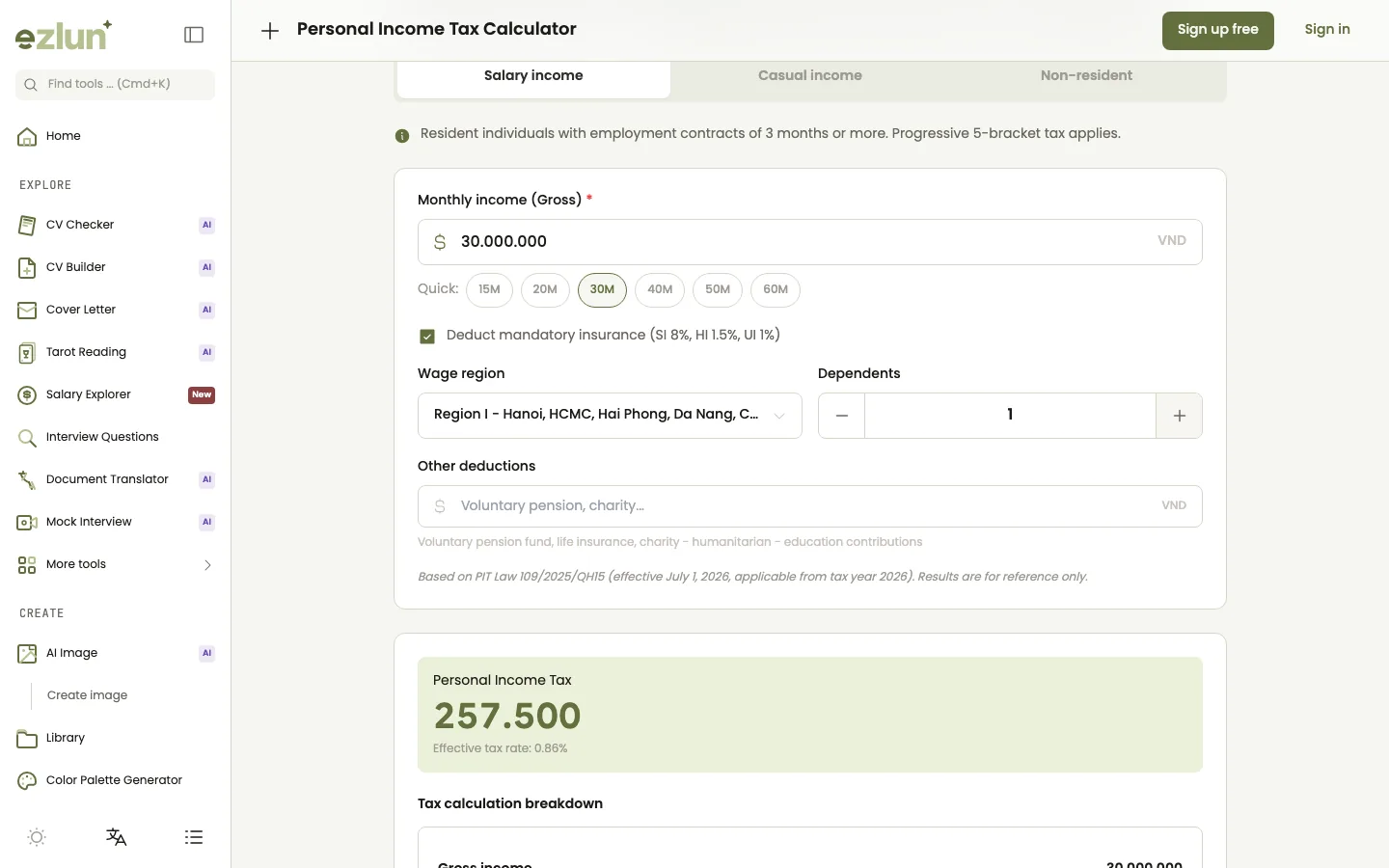
Enter the number of registered dependents so the calculator applies the right deduction.
The result shows your monthly tax, your effective tax rate, a bracket-by-bracket breakdown and a comparison with the old law, so you can see how much you save.
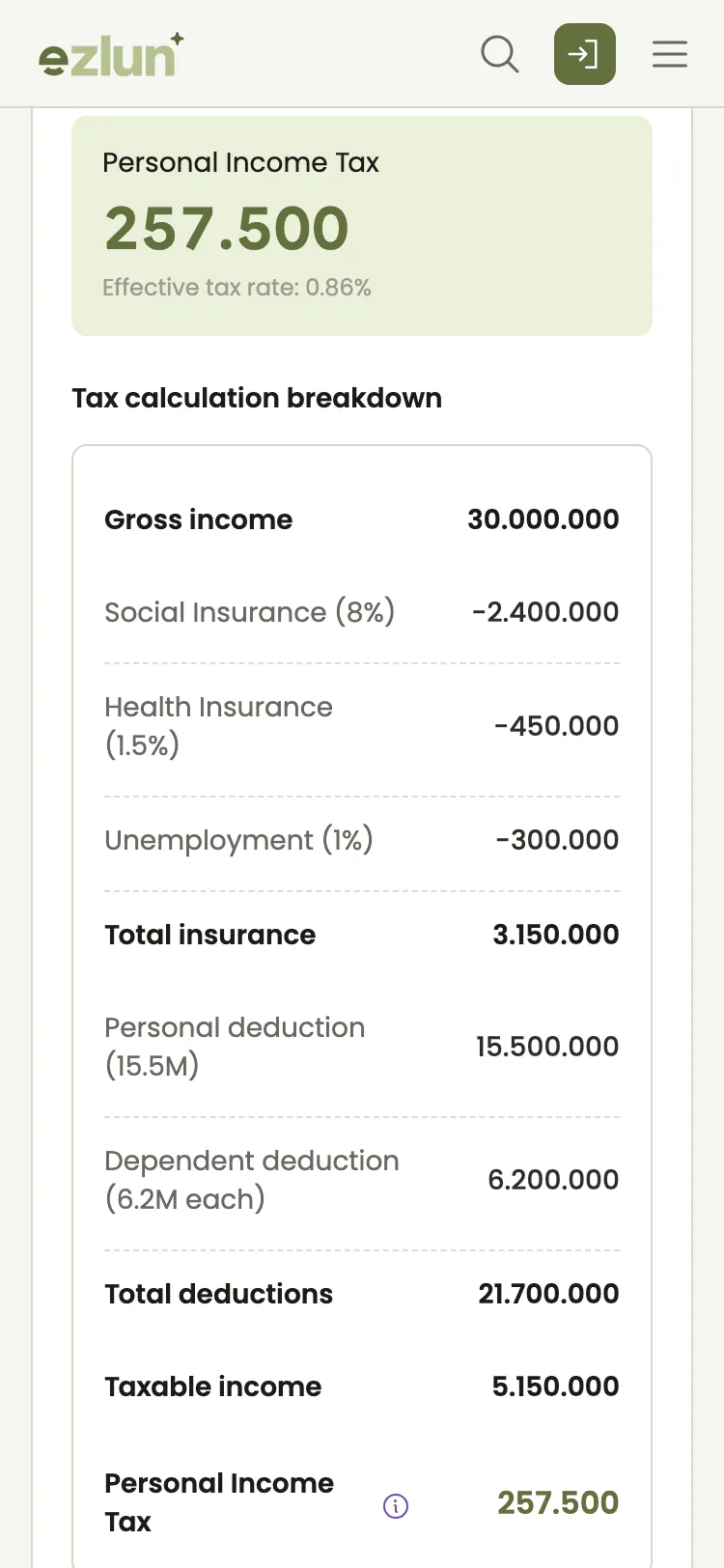
On a phone, the result shows your tax and the old law versus new law comparison.
Limitations of the tool
It works month by month and does not replace the annual finalization. If your income changes during the year, or you are paid by more than one employer, your annual tax may differ from the total withheld each month.
It does not check whether a dependent qualifies. The calculator uses the number you enter; the tax authority decides who qualifies.
It does not subtract tax-exempt income, such as certain allowances or overtime pay. Take those out of your income yourself before entering it.
Legal basis: Personal Income Tax Law No. 109/2025/QH15, applying from the 2026 tax period; Decree 253/2026/ND-CP and Circular 87/2026/TT-BTC, its implementing guidance in force from 1 July 2026. Information is current as of October 2026. Figures are for reference only; please check official sources. This article and the calculator are not a substitute for tax or legal advice.
Frequently asked questions
Can two people claim the same dependent?
No. Each dependent can only be claimed by one taxpayer in the same period. For example, if a married couple has one child, only one of them registers the child. It usually makes sense for the higher earner to claim, since they pay a higher rate and save more.
Can a child over 18 be a dependent?
Yes, if the child has a disability and cannot work, or is still studying and has no income or average income below the maximum set by the tax authority. You will need extra documents, such as a confirmation letter from the school.
Do deductions apply to casual income?
When you receive casual income of VND 5 million or more per payment, the payer withholds 10% straight away, without any family deductions. Below VND 5 million, tax is only withheld if you ask for it. The deductions only count when you finalize your tax at the end of the year. If your total annual income is low, you may get some of the withheld tax back.
When should I register a dependent?
As soon as the support starts, for example when a child is born or when you start supporting a parent. Registering early lets your company apply the deduction in your monthly payroll, instead of you waiting for the year-end finalization to get it back.
Can the calculator replace a tax finalization?
No. It helps you estimate and understand your monthly tax. The year-end finalization must follow the tax authority's instructions, either through your company or on your own, using your real income for the whole year.
Summary
Vietnam's family deductions are VND 15.5 million per month for yourself and VND 6.2 million per month for each dependent, applying from the 2026 tax period. They reduce your taxable income, not your tax directly, and dependents only count once they are registered. Non-residents do not get these deductions.
If you are about to leave a job and want to settle your tax and insurance properly, see the quit your job checklist for Vietnam and unemployment benefits in Vietnam: who is eligible. When weighing two job offers, comparing job offers in Vietnam: gross vs net helps you factor in the tax. For the basics of gross and net pay, read the detailed guide to net vs gross salary.
You can enter your own income and dependents in Ezlun's Personal Income Tax Calculator. It is free and needs no account.


