
How to Calculate Net Salary From Gross in Vietnam (2026 Formula and Example)
 Ezlun Team9 min read

The gross to net salary formula in Vietnam has two deductions: take your gross salary, subtract compulsory insurance (social insurance 8%, health insurance 1.5%, unemployment insurance 1%), then subtract personal income tax (PIT). PIT is charged on what is left after insurance and family deductions, using a 5-bracket progressive scale that applies from the 2026 tax period.
This guide explains each step of the formula for employees in Vietnam, with a worked example in VND and how to work backwards from a net offer to the gross amount.
What is the difference between gross and net salary in Vietnam?
Gross salary is the total pay written in your employment contract, before anything is taken out. Net salary is what actually lands in your bank account each month. The gap between them comes from two groups of deductions:
Your share of compulsory insurance: 10.5% of your insurance salary in total, made up of social insurance (BHXH) 8%, health insurance (BHYT) 1.5% and unemployment insurance (BHTN) 1%.
Personal income tax: only due when your income after insurance is higher than your family deductions.
Job offers in Vietnam are quoted both ways, so it is worth checking which one you are being offered. For a longer look at the two concepts, read the detailed guide to net vs gross salary.
Your employer also pays another 21.5% in insurance on top of your salary. That amount is not taken from your pay.
The gross to net formula, step by step
Work through these 5 steps in order. Each step uses the result of the one before.
Calculate compulsory insurance. Multiply your insurance salary by 10.5%. The insurance salary is usually your gross salary, unless your contract states a different base.
Find your pre-tax income. Pre-tax income = gross salary - compulsory insurance.
Subtract family deductions. You get a personal deduction of VND 15,500,000 per month, plus VND 6,200,000 per month for each registered dependent. See personal income tax deductions in Vietnam for who counts as a dependent.
Apply the 5 tax brackets. Taxable income = pre-tax income - family deductions. If the result is zero or less, you pay no tax.
Get your net salary. Net = gross - compulsory insurance - PIT.
The 5 brackets apply to monthly taxable income:
Bracket | Monthly taxable income | Tax rate |
|---|---|---|
1 | Up to VND 10 million | 5% |
2 | Over 10 to 30 million | 10% |
3 | Over 30 to 60 million | 20% |
4 | Over 60 to 100 million | 30% |
5 | Over 100 million | 35% |
This is a progressive scale: each rate only applies to the slice of income inside that bracket, not to your whole income.
Two insurance caps to know
For higher salaries, insurance does not keep rising with pay:
Social and health insurance are capped at 20 times the reference level. The reference level from 1 July 2026 is VND 2,530,000, so the cap is VND 50,600,000 per month.
Unemployment insurance is capped at 20 times the regional minimum wage. Region I has a minimum wage of VND 5,310,000, so its cap is VND 106,200,000 per month.
For example, a gross salary of VND 60 million only pays social and health insurance on VND 50.6 million. The wage region only changes the unemployment insurance cap.
Worked example: VND 40 million gross, 0 or 1 dependent
Say you work in Region I, earn VND 40,000,000 gross per month, and pay insurance on your full salary.
Item (VND) | 0 dependents | 1 dependent |
|---|---|---|
Gross salary | 40,000,000 | 40,000,000 |
Social insurance 8% | 3,200,000 | 3,200,000 |
Health insurance 1.5% | 600,000 | 600,000 |
Unemployment insurance 1% | 400,000 | 400,000 |
Pre-tax income | 35,800,000 | 35,800,000 |
Family deductions | 15,500,000 | 21,700,000 |
Taxable income | 20,300,000 | 14,100,000 |
Personal income tax | 1,530,000 | 910,000 |
Net salary | 34,270,000 | 34,890,000 |
How the tax in the first column is worked out: the first VND 10 million is taxed at 5%, which is 500,000. The remaining 10.3 million falls in bracket 2 at 10%, which is 1,030,000. Together that makes 1,530,000.
In the second column, one dependent lowers taxable income by VND 6.2 million, so tax falls by 620,000 and net pay rises by the same amount.
At lower salaries, tax can be zero. For a gross salary of VND 20 million with no dependents: insurance is 2,100,000, taxable income is 2,400,000, tax is 120,000 and net pay is 17,780,000. With one dependent, taxable income drops to zero and net pay is 17,900,000.
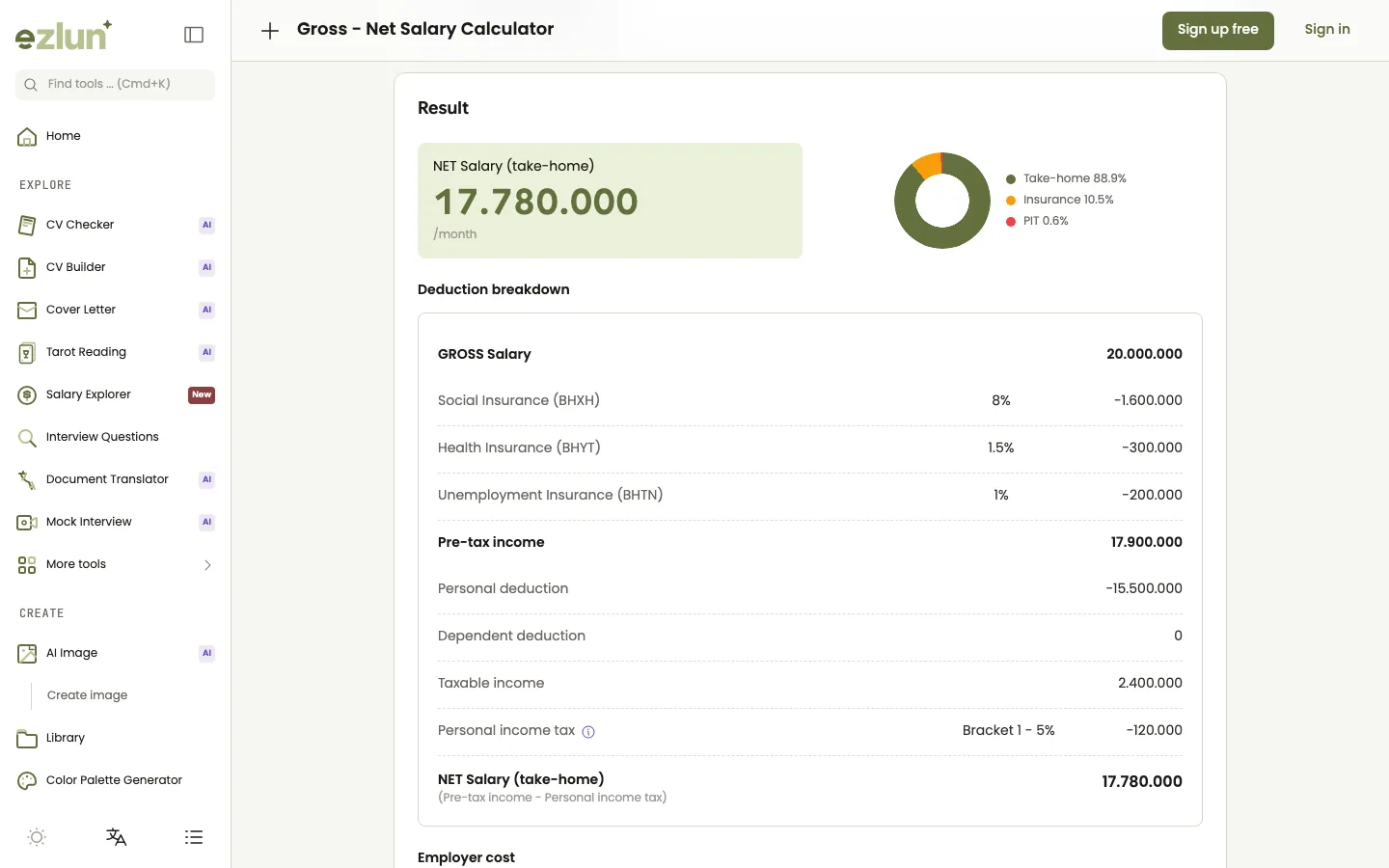
The calculator lists each deduction, your taxable income and the tax for each bracket.
How do you convert net salary back to gross?
When an offer is quoted as net, you need the matching gross figure to compare it fairly. There is no simple division for this, because the progressive tax changes from bracket to bracket.
The correct method is trial and adjustment: pick a gross amount, run the 5 steps above, then raise or lower the gross until the net matches the figure you want. The table above shows one answer: to take home VND 34,270,000 with no dependents in Region I, the gross salary needs to be VND 40,000,000.
Ezlun's calculator does this search for you when you choose NET → GROSS: enter the net amount you want, and it returns the gross salary with the same deduction breakdown.
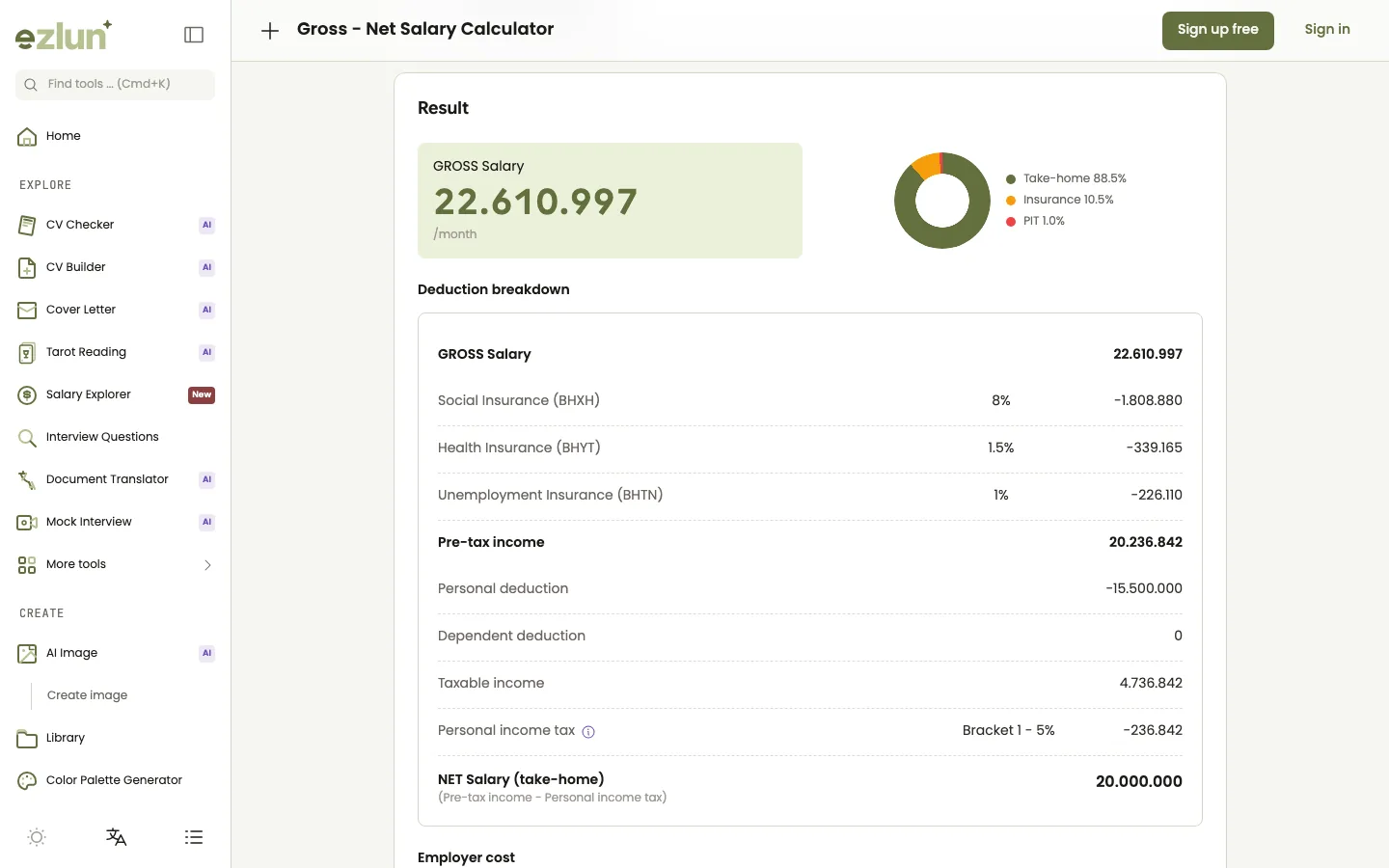
If you are holding two offers, one gross and one net, the guide to comparing job offers in Vietnam: gross vs net shows how to put both on the same footing before you decide.
How to use Ezlun's Gross - Net Salary Calculator
The calculator runs in your browser, is free and needs no account.
Choose the direction: GROSS → NET or NET → GROSS.
Enter your salary, or tap one of the amounts under "Quick select".
Select your Wage region and the number of Dependents.
If your contract sets a lower insurance salary than your gross pay, choose "Custom insurance base" and enter that amount.
Read the result: take-home pay, each insurance line, tax per bracket and the full "Employer cost". You can also use "Download PDF" to keep a copy.
Notes for foreign employees
Tax residency matters. The formula above is for tax residents with an employment contract. Non-residents are taxed differently: a flat 20% on salary income, with no family deductions. Ezlun's Personal Income Tax Calculator has a non-resident mode. Whether you count as a resident depends on rules such as how long you stay in Vietnam, so confirm your status with your employer or a tax adviser.
Insurance can differ. Which insurance types apply to a foreign employee depends on the contract and work permit. Check your payslip or ask HR before relying on the 10.5% figure.
Allowances and benefits such as housing or school fees may be treated differently for tax. The calculator does not cover them.
Legal basis and effective dates
The figures in this article and in the calculator are based on:
Personal Income Tax Law No. 109/2025/QH15: the 5-bracket scale and the deductions of VND 15.5 million for yourself and VND 6.2 million per dependent, applying from the 2026 tax period.
Decree 253/2026/ND-CP and Circular 87/2026/TT-BTC: implementing guidance for the PIT law, in force from 1 July 2026.
Social Insurance Law No. 41/2024/QH15: contribution rates and caps based on the reference level.
Decree 293/2025/ND-CP: regional minimum wages from 1 January 2026.
The reference level of VND 2,530,000 per month, applying from 1 July 2026.
Information is current as of October 2026. Figures are for reference only; please check official sources. This article and the calculator are not a substitute for tax or legal advice. For complex situations, ask an accountant or your company's HR team.
Limitations of the tool
It covers monthly salary for tax-resident employees with a contract. Casual income and non-residents are calculated differently; use the Personal Income Tax Calculator for those.
It does not apply special tax exemptions, such as certain allowances, meal allowances or overtime pay. If your payslip includes these, your real figure may differ.
It does not include other deductions, such as charitable donations or voluntary pension contributions.
Frequently asked questions
Is the insurance salary always the same as gross salary?
Usually, but not always. Some employers set an insurance salary lower than gross pay. That means less insurance is deducted and your monthly net is higher, but your future insurance benefits, such as pension and unemployment benefits, are lower too.
How much does one dependent add to net pay?
Each dependent lowers your taxable income by VND 6.2 million. Your net pay rises by 6.2 million times your top tax rate: about 310,000 in the 5% bracket and 620,000 in the 10% bracket. If you already pay no tax, an extra dependent does not change your net pay.
Are allowances included in the insurance salary?
It depends on the type. Allowances tied to your job are usually included; some benefits are not. Ask HR how your own payslip is set up.
Why do different salary calculators give different results?
Usually for one of four reasons: the calculator still uses the old deductions and tax scale, it handles the insurance caps differently, it uses a different wage region, or it assumes a different insurance salary. When comparing, check that the calculator uses the VND 15.5 million deduction and the 5-bracket scale.
Can the calculator replace an accountant?
No. It helps you estimate quickly and understand each deduction. The official figure is the one on the payslip your company prepares, and the year-end tax finalization can make your annual tax differ from the total withheld each month.
Summary
The gross to net formula in Vietnam fits on one line: net = gross - 10.5% compulsory insurance - personal income tax. Tax is charged on what remains after insurance and family deductions, using the 5-bracket progressive scale. For high salaries, remember the two insurance caps.
To see what the unemployment insurance you pay each month gives you back, read unemployment benefits in Vietnam: who is eligible. To see how your salary compares with the market, check the industry salary comparison for Vietnam in 2026.
If this is your first job, the fresh graduate job checklist for Vietnam also covers probation pay and how it is taxed.
You can enter your own salary in Ezlun's Gross - Net Salary Calculator. It is free and needs no account.


