
Tarot Spreads for Beginners: From 1 Card to the 10-Card Celtic Cross
 Ezlun Team7 min read

Tarot spreads for beginners work best when you keep three things simple: pick a small spread such as one or three cards, ask one clear question, and read each card according to its position in the spread. Treat the cards as prompts for reflection, not as a forecast.
This guide walks through five common spreads, shows how to phrase a question, and explains how to try each one with Ezlun's Tarot Reading.
What is a tarot spread?
A spread is the layout you place your cards in. Each position has its own meaning, so the same card reads differently depending on where it lands. The Tower in a "Challenge" position says something different from the Tower in an "Advice" position.
A standard tarot deck has 78 cards in two groups:
22 Major Arcana cards deal with big themes and turning points.
56 Minor Arcana cards are split into four suits (Wands, Cups, Swords and Pentacles) and cover everyday matters.
A card can also come up upright or reversed. A reversed card is often read as energy that is blocked, delayed or worth looking at from another angle.
Five tarot spreads to learn first
You don't need to memorize dozens of layouts. These five cover most everyday questions, from simplest to most detailed.
Spread | Cards | Positions | Good for |
|---|---|---|---|
Daily Card | 1 | Today's Energy | Starting the day, learning the cards one at a time |
Decision Making | 3 | Situation, Challenge, Advice | Weighing a choice |
Career | 4 | Present, Challenge, Action, Outcome | Questions about work and direction |
Love | 5 | You, Partner, Relationship, Challenge, Potential | Reflecting on a relationship |
Life Overview (Celtic Cross) | 10 | Present, Challenge, Foundation, Past, Possibility, Near Future, Self, Environment, Hopes & Fears, Outcome | Big questions that need the full picture |
A practical way to start: draw a single Daily Card every morning for a week. You'll get used to the names and imagery without feeling overwhelmed. Then move on to the three-card Decision Making spread. Leave the Celtic Cross until you're comfortable, because its ten positions relate to one another and take longer to read.
The three-card spread
The three-card spread is the one most beginners stick with. In the Decision Making layout, the first card describes where you are now, the second shows what's in the way, and the third suggests a direction. Read the Advice card last and ask yourself what one small step it points to.
The Celtic Cross
The Celtic Cross is the classic ten-card spread. The first two cards (Present and Challenge) form the heart of the reading. The rest add context: what the situation is built on, what's behind you, what might come next, how you see yourself, how others influence you, what you hope for or fear, and where things may lead.
How do you ask a good tarot question?
A clearer question gives you a more useful reading. Three rules help:
Ask about yourself, not about someone else. "What can I do to communicate better with my team?" works better than "What does my coworker think of me?"
Ask open questions, not yes or no. "What would help me decide whether to change jobs?" gives you more to work with than "Should I quit?"
One question per spread. Bundling several topics into one draw makes the reading vague.
Vague question | Clearer question |
|---|---|
"What does my future hold?" | "What should I focus on at work over the next three months?" |
"Does this person like me?" | "What do I need to see clearly about this relationship?" |
"Will I get the job?" | "What else should I prepare for next week's interview?" |
How to do a tarot reading with Ezlun
Ezlun's Tarot Reading lets you draw cards on screen. AI then explains each card based on its position, your topic and your question. On the English site, the reading is written in English.
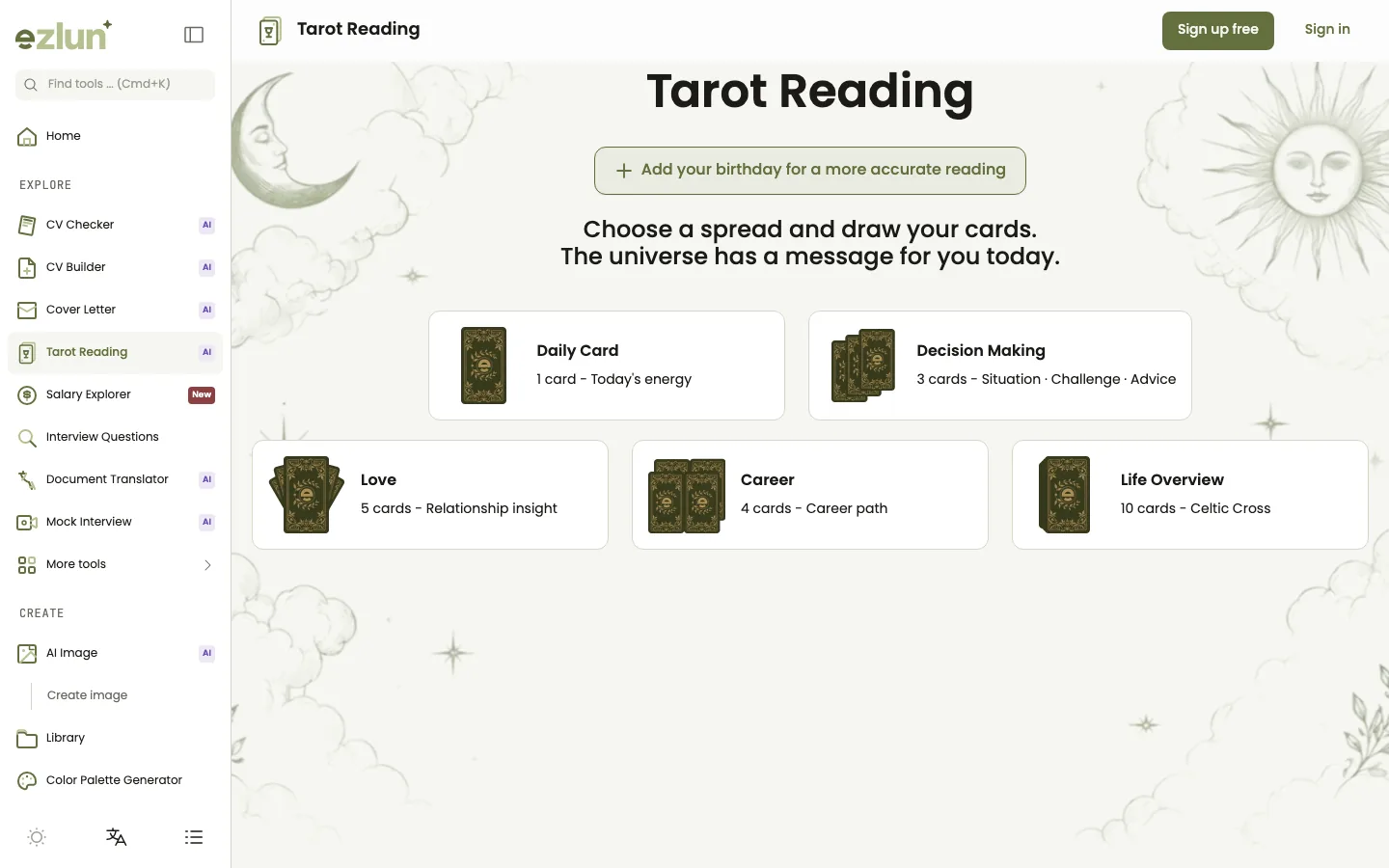
Five spreads, each labeled with its number of cards and what it covers.
Open the tool at ezlun.com/en/tools/tarot and sign in.
Pick a spread: Daily Card, Decision Making, Career, Love or Life Overview.
Choose a topic: General, Love, Work or Study.
Add a specific question (optional). You can also add your birthday if you'd like the reading to mention your zodiac sign.
Shuffle by tapping the deck, then pick the number of cards the spread needs.
Read the result. Each card shows its name, whether it's upright or reversed, its position and an explanation. You can save the result as an image or share a link.
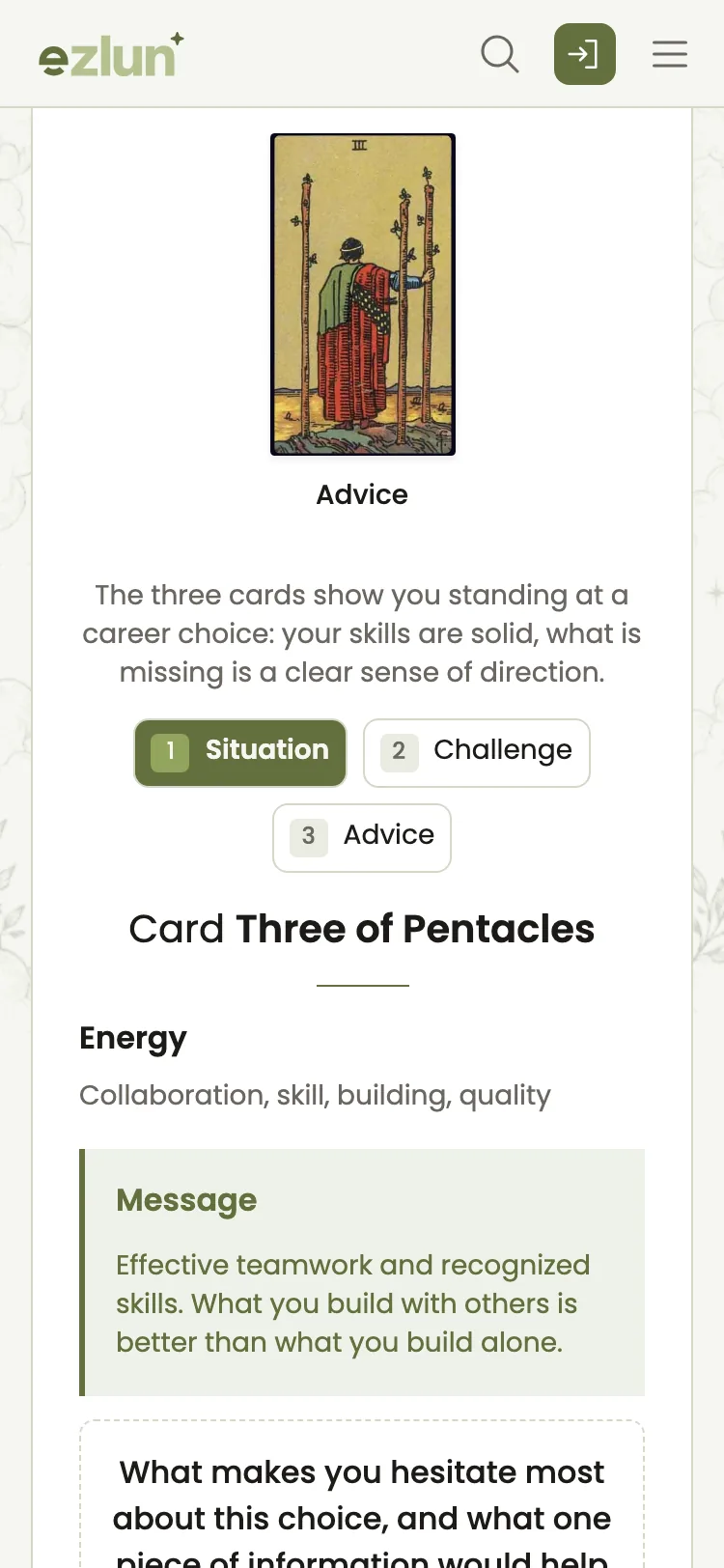
A three-card Decision Making spread: each card is read in its Situation, Challenge or Advice position.
How to read the results without taking them too literally
A healthy way to use tarot is to treat each card as a question you ask yourself. After every spread, try this routine:
Read the Advice or Action card first. That's usually the part you can act on today.
Ask where it fits in your life. If a card talks about a new beginning, think about something you've been putting off starting.
Write down one small action. For example: "This week I'll ask my manager about the promotion path."
Let go of what doesn't fit. If part of the reading has nothing to do with you, don't force it.
If you use tarot to think about your career, pair it with tools grounded in evidence. Our guide to MBTI and the 16 personality types at work gives you another lens on yourself, and personal branding for job seekers helps you turn those reflections into a clear profile. If you love the colors in the cards, how to choose a color palette for a website shows how to build a palette of your own.
Limits of the tool
Please read this before you start:
Tarot is for entertainment and self-reflection. There is no scientific evidence that cards predict the future.
It is not professional advice. For health, money, legal or mental health questions, talk to a qualified professional.
The reading is written by AI. It combines traditional card meanings with your question, so it can be general or miss parts of your situation.
Don't make a major decision based on a single spread.
Frequently asked questions
Is tarot accurate?
There's no scientific evidence that tarot predicts what will happen. Its value is in helping you look at a situation from a different angle and ask yourself better questions. Use it that way.
Which tarot spread should a beginner start with?
Start with the one-card Daily Card. Once the cards feel familiar, move to the three-card Decision Making spread. Keep the ten-card Celtic Cross for later, since its positions are linked and take practice to read.
Do I need an account, and does it cost energy?
Yes, you need to sign in. Each reading uses energy based on the number of cards: 5 for one card, 7 for the three, four and five-card spreads, and 10 for the Celtic Cross. Every account gets 15 free energy each day.
How is an AI reading different from a reading with a person?
A human reader can talk with you, ask about your situation and adjust as you react. The AI reads from the card meanings, positions, topic and the question you typed. It's quick and consistent, but it doesn't know your context beyond what you share. The more specific your question, the more relevant the reading.
How often should I do a reading?
Many people draw a single card each morning as a reminder for the day. For bigger questions, avoid redrawing for the same question just because you didn't like the answer. Give yourself a few days to try what the cards suggested.
Summary
As a beginner, start with one card, ask open questions about yourself, and read each card by its position in the spread. Most of all, treat the reading as a prompt to reflect and act, not as a verdict.
You can try all five spreads with Ezlun's Tarot Reading using your free daily energy.


